
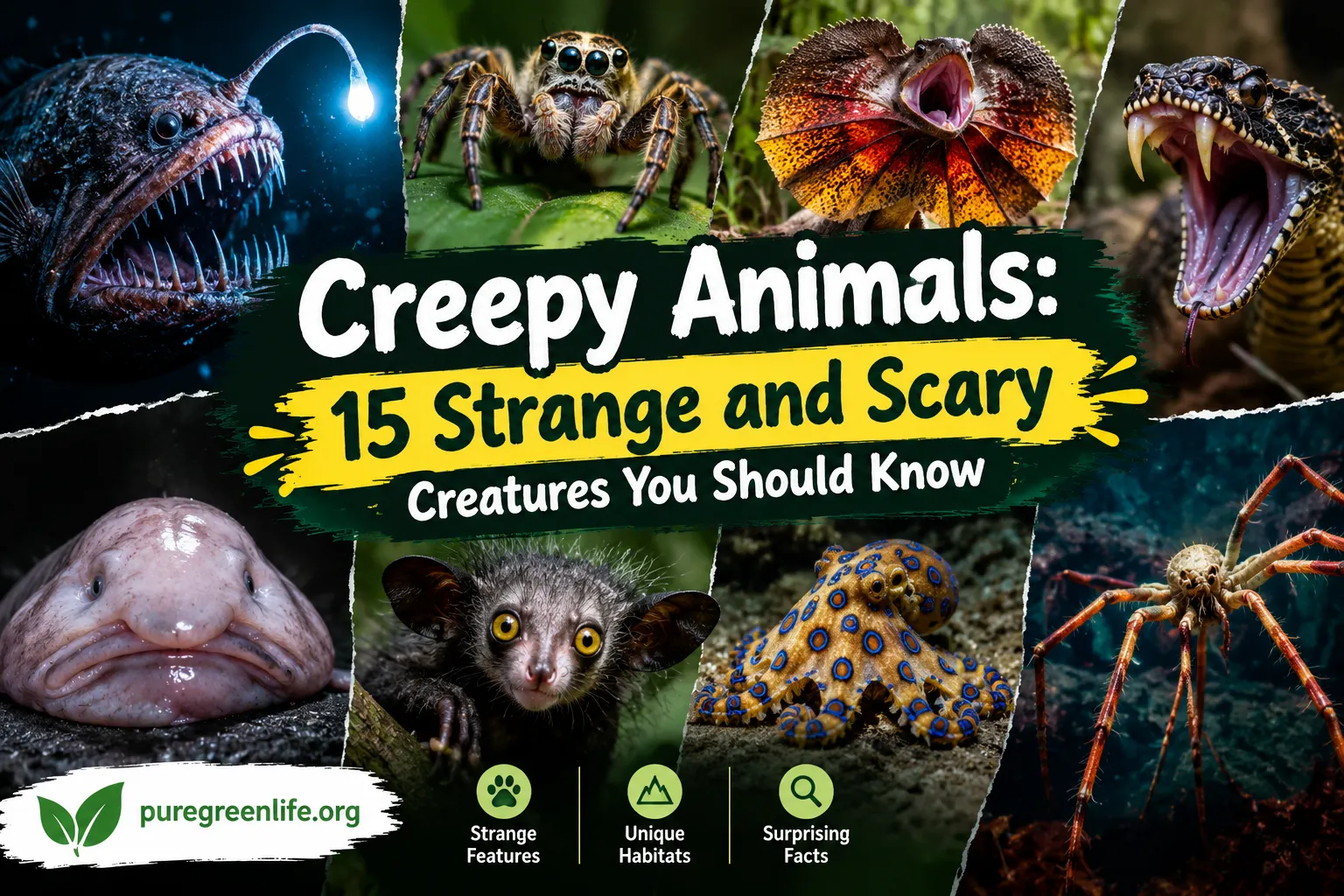
Nature has many animals that look strange, unusual, or even scary. Their odd features often help them survive in the wild. Some have huge teeth, unusual faces, or strange body shapes. Others live in dark places where humans rarely see them. These animals may look creepy, but most are not dangerous to people.
What Makes an Animal Look Creepy?
People often slap the label “creepy” on animals for one simple reason. They just look wrong to us.
Big eyes. Too many legs. Sharp teeth, oddly long fingers, bodies shaped like nothing else in nature. Add in a weird sound or an unnatural way of moving, and suddenly our brains flag it as a threat instantly.
Here’s the thing, though. Almost every one of those “creepy” features exists for a real reason.
Large eyes help nocturnal animals see in near darkness. Sharp teeth aren’t for show, they’re built for hunting or defense. Long fingers often help with climbing, digging, or catching prey other animals simply can’t reach.
Strange movement usually isn’t random either. It’s camouflage, a hunting tactic, or just how that species evolved to survive its specific environment.
So the next time something looks unsettling, remember this: a creepy appearance rarely means danger. More often than not, it just means evolution found a clever, if slightly unsettling, solution.
Creepy Animals You Should Know
Aye-Aye
The aye-aye is a strange-looking lemur from Madagascar. It has large eyes, big ears, and very long fingers.
Its middle finger is especially unusual and extremely thin. The aye-aye uses this finger to find insects under tree bark. It taps on trees and listens for movement inside.
After finding prey, it uses its teeth to open the bark. Then it pulls out insects with its long finger. Aye-ayes are active mainly at night.
Goblin Shark
The goblin shark looks like something from a horror movie. It has a long snout and narrow, pointed teeth.
This deep-sea shark has a very unusual feeding method. Its jaws can quickly extend forward to grab prey.
Goblin sharks usually live deep in the ocean. They eat fish, squid, and other marine animals. Scientists still know little about their natural behavior.
Blobfish
The blobfish is famous for its strange appearance. Its soft body looks very different outside deep water.
This fish lives in deep ocean environments under high pressure. Its body is adapted to those extreme conditions.
The famous droopy appearance often comes from fish brought quickly toward the surface. Lower pressure can change the animal’s body shape.
Blobfish are not naturally floating around looking melted. Their real appearance is better suited to deep water.
Star-Nosed Mole
The star-nosed mole has one of the strangest noses in nature. Its nose has many tiny, sensitive tentacles.
These structures help the mole find food underground. They can detect movement and help identify possible prey.
Star-nosed moles spend much of their time in wet soil. They can also swim and search for food underwater.
Their unusual nose may look creepy to humans. For the mole, it works as a powerful sensory tool.
Naked Mole Rat
The naked mole rat has wrinkled skin and almost no body hair. Its large teeth also make it look unusual.
These animals live underground in parts of eastern Africa. They dig tunnels and live together in large colonies.
Their front teeth help them dig through hard soil. They can also close their lips behind their teeth while digging.
Naked mole rats have special adaptations for underground life. Their unusual bodies help them survive in dark tunnel systems.
Anglerfish
The anglerfish is one of the most famous deep-sea animals. It has a huge mouth and sharp-looking teeth.
Some species have a glowing lure above their mouths. This lure can help bring prey close enough to catch.
Most deep-sea anglerfish live in very dark water. Their bodies have special adaptations for life in the deep ocean.
Some males also have a very unusual mating behavior. In certain species, males attach themselves permanently to females.
Proboscis Monkey
The proboscis monkey is known for its large, unusual nose. Males usually have much larger noses than females.
These monkeys live on the island of Borneo. They spend much of their time in trees near rivers and wetlands.
Their large noses make them look strange to many people. The nose may also help males attract females.
Proboscis monkeys mainly eat leaves, fruits, and other plant material. Their unusual appearance makes them easy to recognize.
Shoebill
The shoebill is a large African bird with a huge bill. Its bill has a hooked tip and sharp edges.
This bird can look almost prehistoric when standing still. It often waits quietly before attacking passing prey.
Shoebills live mainly in freshwater swamps and marshes. Their diet includes fish, eels, snakes, and other animals.
They can stand motionless for long periods while hunting. Their large bill helps them catch and hold large prey.
Giant Isopod
The giant isopod looks like a giant version of a common woodlouse. It has a hard body covering and many legs.
These marine animals live on the ocean floor. Some species live at great depths where sunlight cannot reach.
Giant isopods are scavengers that feed on dead animals. They may also eat other available food on the seafloor.
Their large size makes them look especially strange. Deep-sea conditions help support their unusual body size.
Horseshoe Crab
The horseshoe crab looks like a creature from prehistoric times. Its hard shell covers most of its body.
It also has a long pointed tail called a telson. This tail helps the animal turn itself over.
Despite its name, the horseshoe crab is not a true crab. It belongs to a much older group of animals.
Horseshoe crabs have existed for hundreds of millions of years. Their unusual body shape has helped them survive many changes.
Goliath Birdeater
The Goliath birdeater is one of the world’s largest spiders. It belongs to the tarantula family.
Despite its name, it does not mainly eat birds. Its normal prey includes insects and other small animals.
This spider can defend itself with irritating hairs. It can also make a warning sound by rubbing body parts together.
Its large size makes it look frightening. Still, it usually avoids people when possible.
Vampire Bat
The vampire bat has a spooky name and unusual feeding habits. It is one of the few mammals that feeds on blood.
These bats live in parts of Central and South America. They usually feed on the blood of other animals.
Their sharp teeth make small cuts in the skin. The bat then drinks the flowing blood.
Vampire bats have special adaptations for this unusual diet. Their saliva also contains substances that help keep blood flowing.
Tasmanian Devil
The Tasmanian devil is a small but powerful Australian marsupial. It has a large head and strong jaws.
These animals can make loud sounds when threatened or competing for food. Their sharp teeth also give them a fierce appearance.
Tasmanian devils are mainly scavengers and carnivores. They can eat meat, bones, and other animal remains.
They are found in the wild only in Tasmania. Their strong jaws help them make use of many parts of carcasses.
Axolotl
The axolotl looks unusual because it keeps its young features as an adult. It has feathery gills around its head.
This amphibian comes from Mexico. Wild axolotls are now critically endangered.
Axolotls can regenerate several body parts. They can regrow limbs and repair certain damaged tissues.
Their wide mouths and external gills give them a strange appearance. Despite that look, axolotls are not dangerous to humans.
Frilled Shark
The frilled shark looks more like an ancient creature than a modern shark. It has a long body and unusual teeth.
Its name comes from the frilly appearance around its gill openings. The shark usually lives in deep ocean waters.
Frilled sharks have long, narrow bodies suited to deep-water life. Their jaws contain many sharp, backward-pointing teeth.
Scientists rarely see these sharks in their natural habitat. Their deep-water lifestyle makes them difficult to study.
Why Do These Animals Look So Strange?
Most strange animal features have a biological purpose. Long teeth can help catch prey or defend against threats.
Large eyes can help animals see in low light. Special noses can detect food or sense danger.
Some animals also have unusual bodies because of their habitats. Deep-sea animals often develop unique features for extreme conditions.
These adaptations may look creepy to humans. For the animals themselves, they are useful survival tools.
Are Creepy Animals Dangerous?
Looking scary does not mean an animal is dangerous. Many creepy-looking animals avoid humans whenever possible.
Some can defend themselves when threatened. Others have sharp teeth, venom, or other protective features.
Wild animals should always receive plenty of space. It is safer to observe them without touching or disturbing them.
Remember that appearance can be misleading. Many strange animals play important roles in their ecosystems.
Final Thoughts on Creepy Animals
Creepy animals show how different life can look in nature. Their unusual features often help them survive.
The aye-aye uses a long finger to find hidden insects. The anglerfish uses a glowing lure to attract prey. Axolotls can regenerate several body parts.
These animals may look frightening at first glance. Still, their strange features tell interesting stories about survival and adaptation.







Thank you for reading! These animals really are fascinating. Their unique abilities and survival skills make them worth learning about.