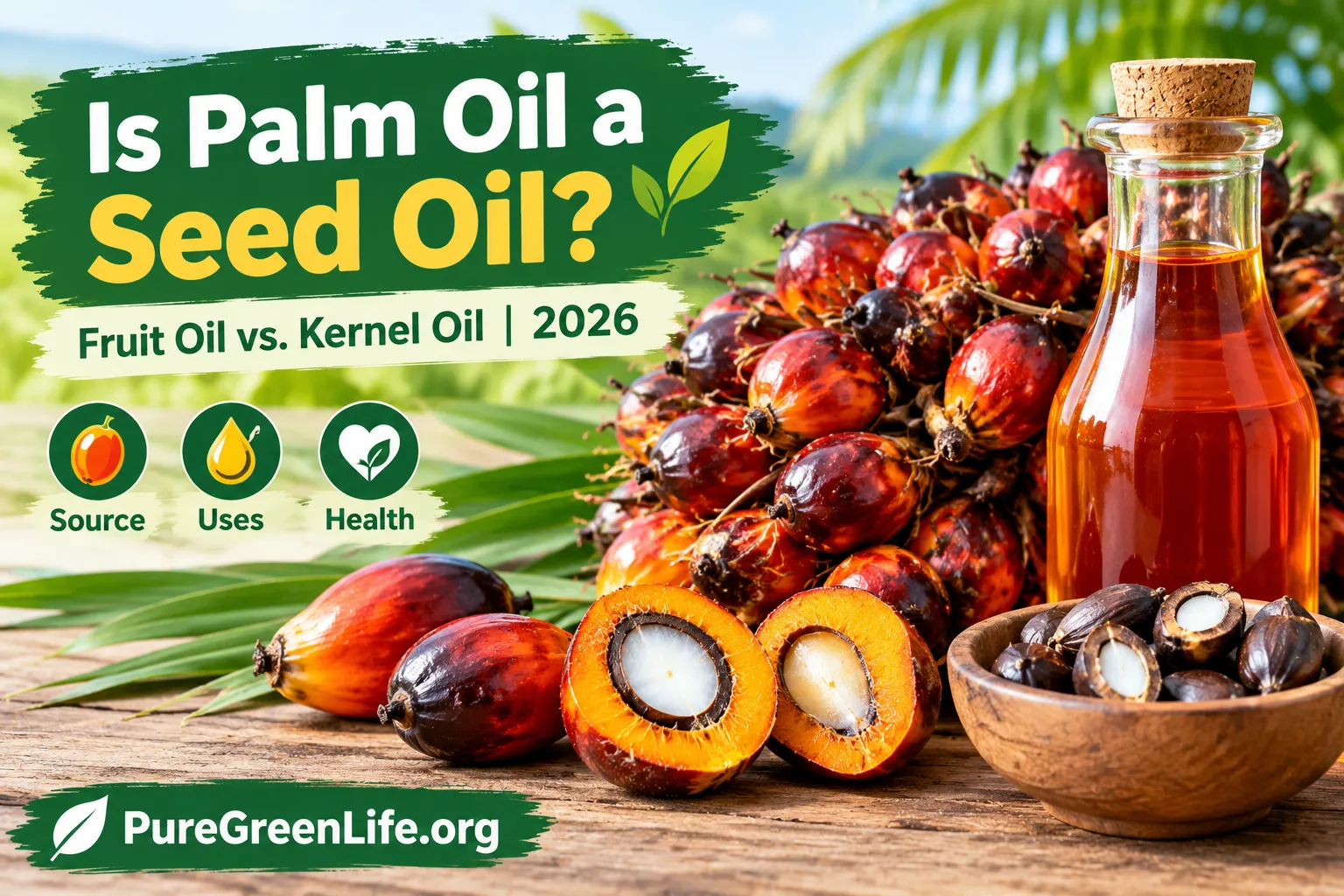
Palm oil appears in foods, soaps, cosmetics, and household products. It is often confused with seed oils, but regular palm oil comes from the fleshy part of a fruit. The same fruit also has a kernel inside, and it gives a different kind of oil.
Is Palm Oil Considered a Seed Oil?
No. Regular palm oil is a fruit oil made from the soft, oily flesh of the oil palm fruit. The scientific name of the African oil palm is Elaeis guineensis. The fruit grows in large bunches and contains an outer skin, fleshy pulp, a hard shell, and a kernel inside.
The pulp produces palm oil. The kernel produces palm kernel oil. Both oils come from the same fruit, but they are not the same product. The Codex Standard for Named Vegetable Oils, published by the Food and Agriculture Organization (FAO), makes this distinction clear. citeturn264348search3
🟨 Added important information: If a label says “palm kernel oil,” that oil is seed-derived. If it says “palm oil” or “palm fruit oil,” it refers to oil from the fruit’s fleshy pulp.
Palm Oil vs. Palm Kernel Oil
The names sound similar, so they are easy to confuse. Their source, fat composition, and common uses are different.
| Feature | Palm Oil | Palm Kernel Oil |
| Source | Fleshy pulp of the fruit | Kernel or seed inside the fruit |
| Oil category | Fruit oil | Seed oil |
| Fat profile | Roughly half saturated and half unsaturated fats | Higher in saturated fats, including lauric acid |
| Common uses | Cooking, frying, spreads, packaged foods | Soaps, cosmetics, confectionery fats |
| Typical appearance | Red-orange when unrefined; often pale after refining | Usually pale or creamy after processing |
Exact composition and appearance vary by product and processing. citeturn264348search0turn264348search12turn264348search1
How Is Palm Oil Made?
Fresh fruit bunches go to a mill, where heat helps loosen the fruit and protect oil quality. The pulp is pressed, and the raw oil is cleaned. It may then be refined to remove impurities, colour, and odour.
The kernel is separated, cracked, and processed to extract palm kernel oil. One fruit therefore supplies two different oils. citeturn264348search10turn264348search12
What Is Palm Oil Used For?
You can find palm oil in many foods, such as cooking oil, instant noodles, baked goods, margarine, snacks, and spreads. Its texture and stability can help give products a smooth feel and longer shelf life.
It is also used in soaps, cosmetics, detergents, and biofuel. Palm kernel oil is common in soap and personal-care products. Check labels carefully because palm oil and palm kernel oil are different ingredients.
Is Palm Oil Healthy?
Just because palm oil comes from a fruit, that does not make it healthy or unhealthy. It contains saturated and unsaturated fats, plus vitamin E compounds. Unrefined red palm oil also contains carotenoids, some of which may be reduced during refining.
The main thing to look at is its saturated fat. Eating too much saturated fat can raise LDL (“bad”) cholesterol for many people. The World Health Organization recommends limiting saturated fat and replacing it with unsaturated fats when possible. citeturn264348search6
🟨 Added important information: Do not rely on claims that palm oil “boosts metabolism,” prevents disease, or is heart-healthy on its own. Health effects depend on the whole diet, how much is eaten, and what fats it replaces. Check the saturated-fat amount on the nutrition label, especially in packaged snacks and baked goods.
Is Palm Oil Harmful to the Environment?
Palm oil production can drive deforestation, wildlife habitat loss, and greenhouse gas emissions when forests are cleared for plantations. The impact depends on where and how the crop is grown.
Oil palm can produce more oil per unit of land than several other oil crops. If we replace palm oil without thinking about land use, the harm to nature may just move somewhere else. Reducing deforestation and supporting responsible production are important goals.
How Can You Choose More Responsible Palm Oil?
Look for clear sourcing information and credible certification, such as the Roundtable on Sustainable Palm Oil (RSPO). Certification sets environmental and social requirements, but its results still need independent monitoring. A 2025 study examined possible unintended effects of certification on plantation efficiency, showing that sustainability systems need ongoing evaluation. citeturn264348search13
Consumers can compare labels and ask brands about unclear sourcing.
Frequently Asked Questions
Is palm oil a seed oil?
No. Regular palm oil comes from the fleshy pulp of the oil palm fruit.
Is palm kernel oil a seed oil?
Yes. Palm kernel oil is extracted from the kernel, which is the seed inside the fruit.
Is palm oil the same as coconut oil?
No. Both come from palm-family plants, but they come from different plants and plant parts. Palm oil comes from the pulp of the oil palm fruit, while coconut oil comes from the kernel of a coconut.
Should I avoid palm oil completely?
That is a personal dietary and environmental choice. For health, monitor saturated fat and overall diet quality. For sustainability, look for credible sourcing information and avoid products linked to deforestation where possible.
Conclusion
In short, palm oil is a fruit oil, not a seed oil. Palm kernel oil, on the other hand, comes from the seed inside the same fruit, so the two oils have different properties and uses. Also, palm oil contains saturated fat, so portion size and the overall diet matter. Besides, palm oil farming can hurt the environment when companies clear forests to make space for plantations. For this reason, it helps to read labels, check nutrition facts, and choose responsibly sourced products.
. Reading labels, checking nutrition facts, and choosing responsibly sourced products can help.
Sources for Further Reading
- FAO, Codex Standard for Named Vegetable Oils: https://www.fao.org/4/y2774e/y2774e04.htm
- Food Standards Australia New Zealand, Palm Oil: https://www.foodstandards.gov.au/consumer/our-safe-food-supply/palm-oil
- World Health Organization, Saturated and trans-fatty acid intake guideline: https://www.who.int/publications-detail-redirect/9789240073630
- Oklahoma State University Extension, Properties of Palm Oil: https://extension.okstate.edu/fact-sheets/properties-of-palm-oil
- Communications Earth & Environment (2025), research on palm-oil certification: https://www.nature.com/articles/s43247-025-02150-2





2 thoughts on “Is Palm Oil a Seed Oil? 7 Facts About Its Source, Uses, and Health in 2026”