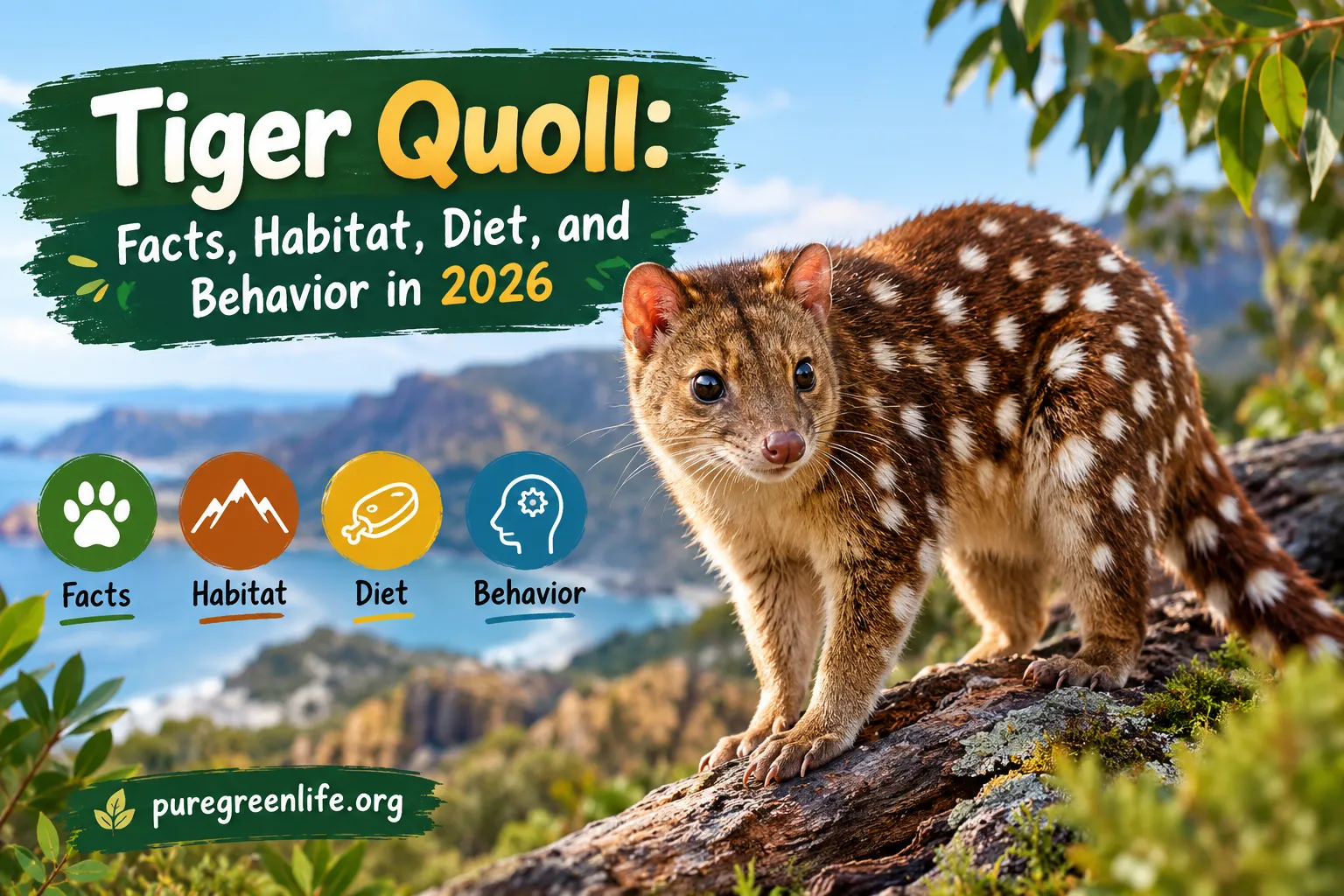
The Tiger Quoll is one of Australia’s most interesting native marsupials. It is also known as the Spotted-tailed Quoll because of its unique spotted tail. This animal is a skilled hunter that lives mainly in forests and woodlands.
Tiger Quolls are difficult to spot because they are mostly active at night. They also need large areas of suitable habitat to survive. Sadly, habitat loss and other threats have reduced their numbers across much of their range.This guide explains the Tiger Quoll’s appearance, habitat, diet, behavior, threats, and conservation. It also covers where Tiger Quolls live and why protecting them matters.
What Is a Tiger Quoll?
The Tiger Quoll is a carnivorous marsupial native to eastern Australia. Its scientific name is Dasyurus maculatus. It is also called the Spotted-tailed Quoll or Spot-tailed Quoll.
The species belongs to the family Dasyuridae. This family includes several Australian carnivorous marsupials. The Tiger Quoll is one of the largest living marsupial carnivores in Australia.It has a long body, short legs, sharp claws, and a hairy tail. White spots cover its body and continue along its tail. This feature helps distinguish it from other Australian quoll species.
The Australian Museum lists its body length at about 35 to 75 centimeters. The Tiger Quoll is also the second-largest carnivorous marsupial in Australia. Only the Tasmanian Devil is larger.
What Does a Tiger Quoll Look Like?
Tiger Quolls have a strong body built for hunting. Their fur can range from sandy and reddish tones to dark brown. White spots cover their back, sides, and tail.
Their faces have a pointed shape with strong jaws and well-developed canine teeth. These features help them catch and kill prey.
Unlike some other quolls, the Tiger Quoll has spots that continue across its tail. This is one of its most useful identifying features.Males are generally larger and heavier than females. Their size can vary between different populations and regions.
The animal also has strong feet and sharp claws. These features help it climb, move across rough ground, and catch prey.
Where Do Tiger Quolls Live?
Tiger Quolls live mainly in eastern Australia. Their range includes Queensland, New South Wales, Victoria, and Tasmania.They can live in several forest habitats. These include rainforests, wet forests, dry forests, woodlands, and heath areas.
Tiger Quolls often use areas with rocks, fallen logs, gullies, and dense vegetation. These places provide shelter and access to prey.They may also live near farmland when suitable natural habitat remains nearby. Still, highly disturbed areas usually provide poorer habitat for them.
The species needs safe places for dens and resting areas. Hollow logs, rock crevices, caves, and other sheltered locations can provide useful protection.
Tiger Quoll Habitat and Range
Tiger Quolls need more than food to survive. They also need connected habitat with suitable shelter and den sites.Large home ranges can be important because prey may not always be found close together. Habitat fragmentation can therefore create serious problems.
When forests are cleared, Tiger Quolls can lose both food sources and shelter. Roads can also divide suitable habitat into smaller areas.
The southeastern mainland population occurs across parts of southeastern Queensland, New South Wales, and Victoria. Tasmania also supports a population of Tiger Quolls.A separate population occurs in northeastern Queensland. This population is known as the northern spotted-tailed quoll.
What Do Tiger Quolls Eat?
Tiger Quolls are carnivores, so they mainly eat other animals. Their diet can include birds, reptiles, and mammals.
They can hunt animals that are smaller than themselves. Their strong jaws and sharp teeth help them handle different types of prey.
Their food can include possums, gliders, bandicoots, rabbits, birds, and reptiles. They may also eat carrion when they find it.Because they are skilled predators, Tiger Quolls can affect the populations of other animals. They form an important part of the food web in their natural habitats.
Their diet can change depending on what prey is available. Therefore, protecting healthy ecosystems also helps protect their food supply.
How Do Tiger Quolls Hunt?
Tiger Quolls usually hunt at night. Their nighttime activity helps them search for prey while avoiding some daytime risks.They have strong senses that help them locate animals in their surroundings. Their sharp teeth and powerful jaws make them effective predators.
A Tiger Quoll can attack prey by biting the back of the skull or neck. This hunting method allows it to kill prey efficiently.They can hunt both on the ground and around trees. Their flexible behavior helps them take advantage of different food sources.
Are Tiger Quolls Nocturnal?
Yes, Tiger Quolls are mainly nocturnal animals. They are generally more active after sunset and during the night.
During the daytime, they usually rest in protected locations. These places can include caves, rock crevices, and hollow logs.Their nighttime behavior makes them difficult for people to see. Even in areas where they still occur, sightings can be uncommon.For this reason, scientists often use cameras and other survey methods to study their populations.
Tiger Quoll Behavior
Tiger Quolls are generally solitary animals. Adults usually live and hunt alone outside the breeding period.
They can travel across large areas while searching for food. Their movements also depend on habitat quality and prey availability.
Tiger Quolls are strong climbers and capable ground hunters. Their physical abilities help them use different parts of their habitat.They are also secretive animals. This behavior helps explain why population numbers can be difficult to measure.
Researchers continue to study their movements, habitat use, and population changes. Better information can help improve conservation planning.
When Do Tiger Quolls Breed?
Tiger Quolls usually breed during the cooler months. Breeding commonly occurs during winter.
Females carry their young and provide care after birth. Like other marsupials, Tiger Quolls raise their young using a pouch.Young quolls are very small when they are born. They continue developing while receiving protection and nourishment from their mother.
Successful breeding depends on healthy adult populations and suitable habitat. Therefore, habitat protection is important for future generations.
How Long Do Tiger Quolls Live?
Tiger Quolls have relatively short lifespans compared with many larger mammals. Their survival depends on food, habitat, disease, predators, and human-related threats.
Young animals face additional risks while becoming independent. Roads, introduced predators, and habitat changes can increase these risks.Wild Tiger Quolls are difficult to study over their entire lifespan. As a result, researchers continue gathering information about their population biology.
Are Tiger Quolls Dangerous?
Tiger Quolls are wild predators, but they generally avoid people. They are not animals that normally seek human contact.
Their sharp teeth and claws can cause injuries if they are handled. People should therefore never try to catch or hold a wild quoll.If you see one in nature, the safest choice is to watch from a distance. Giving the animal space also reduces stress and disturbance.
Tiger Quolls are important native predators. Their behavior should be understood as part of their natural role.
Why Are Tiger Quolls Important?
Tiger Quolls play an important role as top predators in Australian ecosystems. They help control populations of different prey animals.
Healthy predator populations can support balanced ecosystems. Their presence can also indicate that suitable habitat remains available.Protecting Tiger Quolls can therefore benefit other native species too. Conservation efforts often protect forests, shelter sites, and wider wildlife communities.
Their survival also has scientific value. Studying Tiger Quolls helps researchers understand Australia’s unique marsupial wildlife.
What Threatens Tiger Quolls?
Tiger Quolls face several serious threats across their range. Habitat loss and habitat fragmentation remain major concerns.Land clearing can remove forests and important shelter sites. Logging can also reduce features such as hollow trees and fallen logs.
Road traffic creates another serious risk. Quolls can be killed when they cross roads while moving through their home ranges.
Introduced predators can create additional pressure. Foxes, feral cats, and dogs may compete with or prey on native wildlife.Some pest-control methods can also affect Tiger Quolls. Poison baiting is an important conservation concern because non-target animals may be exposed.
Other threats include bushfires, inappropriate burning, disease, climate change, and human disturbance.
Habitat Loss and Fragmentation
Habitat loss can make survival much harder for Tiger Quolls. Forest clearing removes places where they hunt and rest.
Fragmentation creates another problem by separating remaining habitat patches. Animals may then need to cross unsafe areas between suitable forests.Roads can make these movements even more dangerous. They can also divide populations and reduce access to important resources.
For that reason, protecting connected forests is an important conservation action.
Introduced Predators
Introduced predators can affect Tiger Quolls in several ways. Foxes and feral cats may prey on native animals.Foxes can also compete with Tiger Quolls for food. This competition may become more serious when natural prey is limited.
Wild dogs may create additional pressure in some areas. Their effects can vary depending on local conditions.Managing introduced predators can therefore support native wildlife. Conservation programs must consider these interactions when protecting Tiger Quoll populations.
Road Deaths and Human Activity
Roads create a major danger for animals that travel across large areas. Tiger Quolls can be killed when crossing roads.This threat becomes more serious when roads pass through suitable forest habitat. Traffic can also affect other wildlife living in the same areas.
Wildlife crossings and careful road planning can help reduce these risks. Drivers can also help by slowing down in areas known for wildlife activity.Small actions can make a difference when many animals use the same landscape.
Tiger Quoll Conservation Status
The conservation status of Tiger Quolls depends on the population being considered. Australian government assessments recognize different populations and taxa.The southeastern mainland population is listed as endangered under Australia’s EPBC Act. The Tasmanian population is listed as vulnerable.
The northern Queensland population, Dasyurus maculatus gracilis, is also listed as endangered under the EPBC Act.
The Australian Museum currently lists the species as Endangered on the IUCN Red List.These classifications show why continued conservation work remains important.
How Are Tiger Quolls Protected?
Conservation programs focus on protecting suitable habitat and reducing major threats. Protecting forests can preserve food sources and den sites.Researchers also monitor populations to understand where Tiger Quolls still occur. Camera traps and other survey methods can help detect these secretive animals.
Reducing road deaths can also support local populations. Wildlife-friendly planning can improve movement between habitat areas.
Controlling introduced predators may provide additional benefits. However, pest-control programs must consider their possible effects on native animals.The national recovery plan also focuses on improving knowledge and reducing threatening processes.
Where Can You See a Tiger Quoll?
Tiger Quolls are difficult to see in the wild. They are mostly active at night and often remain hidden during daylight.They occur in several protected areas across eastern Australia. However, simply visiting a forest does not guarantee a sighting.Wildlife cameras can detect them more easily than people. Researchers use these tools to understand their distribution and activity.If you encounter one, keep your distance and avoid disturbing it. Quiet observation is safer for both the animal and the visitor.
Tiger Quoll vs Other Australian Quolls
Australia has several different quoll species. The Tiger Quoll is the largest of the quolls.Its most noticeable feature is the white spotting that continues onto the tail. Other quoll species have different body patterns and sizes.
The Tiger Quoll also has a powerful body and strong hunting abilities. These traits help it capture relatively large prey.Learning these differences can make quoll identification easier. It also helps people understand Australia’s diverse native marsupials.
Interesting Tiger Quoll Facts
Tiger Quolls are among Australia’s largest living marsupial carnivores. They are smaller than the Tasmanian Devil but remain powerful predators.Their scientific name is Dasyurus maculatus. The species occurs across parts of eastern Australia.White spots continue along their tails, which helps identify them. They mainly hunt at night and rest during the day.Tiger Quolls can use hollow logs, caves, and rock crevices as shelters. Their diet includes birds, reptiles, and mammals.They face serious threats from habitat loss and introduced predators. Road deaths and other human pressures also affect populations.
How Can People Help Tiger Quolls?
Protecting native forests is one of the best ways to help Tiger Quolls. Healthy forests provide food, shelter, and breeding areas.People can also support responsible wildlife conservation programs. Avoiding disturbance near known wildlife habitat is another useful step.Drivers should slow down when traveling through forest areas. This can reduce the risk of wildlife collisions.People should never feed, chase, or handle wild Tiger Quolls. Respecting their natural behavior gives them a better chance of survival.Supporting habitat restoration can also benefit many other Australian species. Conservation works best when entire ecosystems are protected.
Final Thoughts on Tiger Quolls
The Tiger Quoll is a remarkable Australian predator with an important role in native ecosystems. Its spotted body and tail make it one of Australia’s most recognizable quolls.These animals live mainly in forests, woodlands, and heath habitats. They hunt at night and eat a wide range of prey.Sadly, Tiger Quolls face growing pressure from habitat loss and other threats. Road deaths, introduced predators, and habitat fragmentation can reduce local populations.Therefore, protecting connected forests is essential for their future. Conservation programs can also reduce threats and improve population monitoring.With better habitat protection and careful wildlife management, Tiger Quolls can continue surviving in Australia. Protecting this species also helps preserve Australia’s unique natural environment.