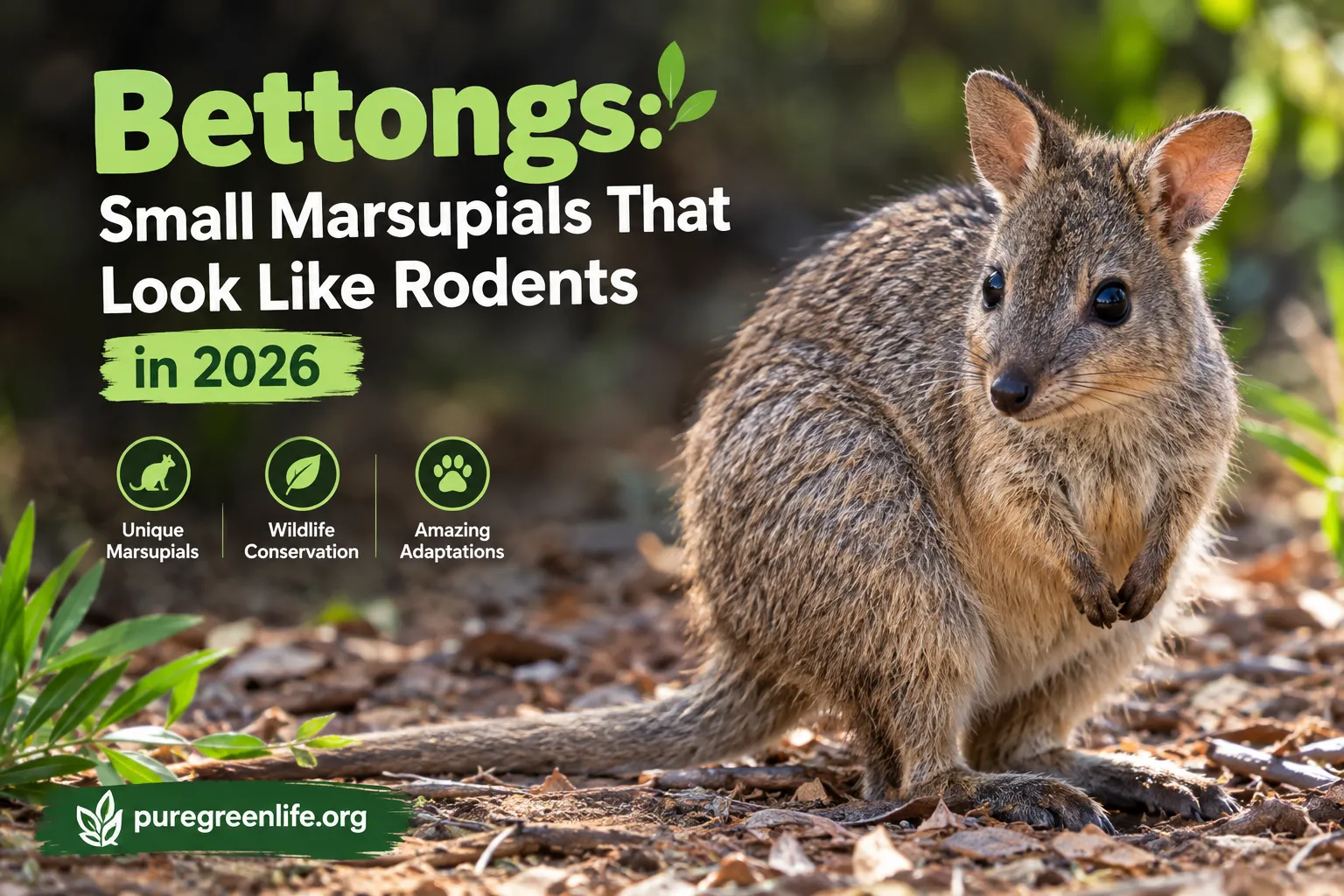
Ever seen a tiny animal that looks like a big rat but hops like a kangaroo? That is a bettong. Many people have never heard of bettongs, yet these little Australian marsupials do a big job for nature. In this guide, you will learn what bettongs are, where they live, what they eat, and why they are making a comeback.
Quick Answer: What Are Bettongs?
- What they are: Small, rodent-like marsupials from Australia
- Family: Related to kangaroos, not rats or mice
- Food: Mostly fungi, like truffles, plus roots and seeds
- Status: Several species are endangered, but reintroductions are helping
What Are Bettongs?
So, what are bettongs? They are small marsupials, also called rat-kangaroos. They hop on their back legs, and the mothers carry their babies in a pouch.
However, they are not rodents at all. In fact, they are closer cousins to kangaroos and wallabies.
Why Bettongs Look Like Rodents
At first glance, you could easily mistake a bettong for a big rat. They have a pointy nose, round ears, and a long tail. That is why people call them rodent-like marsupials.
But look closer. Bettongs have strong back legs and small front paws, just like tiny kangaroos. Also, their long tail can hold things, which no rat can do as well.
Types of Bettongs in Australia
There are five bettong species. Each one lives in a different place and faces different dangers.
- Brush-tailed bettong (woylie): Critically Endangered
- Northern bettong: Endangered
- Eastern bettong (Tasmanian population): Near Threatened
- Burrowing bettong (boodie): Near Threatened
- Rufous bettong: Least Concern
These are the IUCN ratings. In Australia, the woylie is also listed as Endangered under national law.
Bettong Size: Smaller Than a Cat
Bettongs are small. Most grow to 30 to 38 cm long, and their weight goes from about 1.2 kg to 2.8 kg. The northern bettong is the smallest, while the rufous bettong is the biggest.
For comparison, a burrowing bettong weighs around 1.3 kg. That is about the weight of a small bag of sugar.
Bettong Habitat: Where Do Bettongs Live?
Bettongs live in Australia, in woodlands, shrublands, and dry forests. Each species has its own home. For example, the eastern bettong lives in Tasmania, while the northern bettong lives only in north-east Queensland.
The burrowing bettong is special. It is the only bettong that digs warrens, which are deep underground homes with many tunnels. Today, it lives mostly in fenced sanctuaries because foxes and cats wiped it out on the mainland.
Bettong Diet: What Do Bettongs Eat?
Bettongs love fungi. Truffles and other underground fungi are their favorite food. They also eat roots, seeds, and a few insects.
To find food, bettongs sniff the ground and dig small holes. Then they eat the fungi and leave. This simple habit helps the soil, as you will see below.
Bettong Behavior: Shy, Nocturnal, and Busy
Bettongs come out at night. During the day, they hide in nests made of grass and bark. They even carry the nest material with their curled tails.
Most bettongs live alone. However, burrowing bettongs share warrens and live in groups. This makes them different from the other species.
Why Bettongs Are Called Ecosystem Engineers
Every time a bettong digs, it mixes the soil and spreads fungal spores. Because of this, the soil gets healthier and plants grow better. That is why scientists call bettongs ecosystem engineers.
So when bettongs disappear, the land suffers too. That is one big reason why people work so hard to save them.
Are Bettongs Endangered?
Yes, many of them are. Foxes and feral cats hunt bettongs, and habitat loss makes things worse. The burrowing bettong is now extinct on the mainland outside predator-proof fences.
However, there is hope. Fenced sanctuaries keep predators out and give bettongs a safe place to live.
Good News: Bettongs Are Coming Back
Recent reintroduction projects are working well. For example, 55 brush-tailed bettongs were released in the Pilliga area of New South Wales in September 2022. They had been gone from that state since the early 1900s.
Also, around 200 brush-tailed bettongs were released on South Australia’s Yorke Peninsula between 2021 and 2023. Experts say the project is doing even better than expected.
Conclusion
Bettongs may look like rodents, but they are small, hopping marsupials with a big job in nature. They dig, spread fungi, and keep Australian soil healthy. Sanctuaries and reintroductions are giving them a second chance.
So, would you like to see a bettong in the wild one day?
Visit puregreenlife.org for more simple guides on wildlife, nature, and sustainable living.