
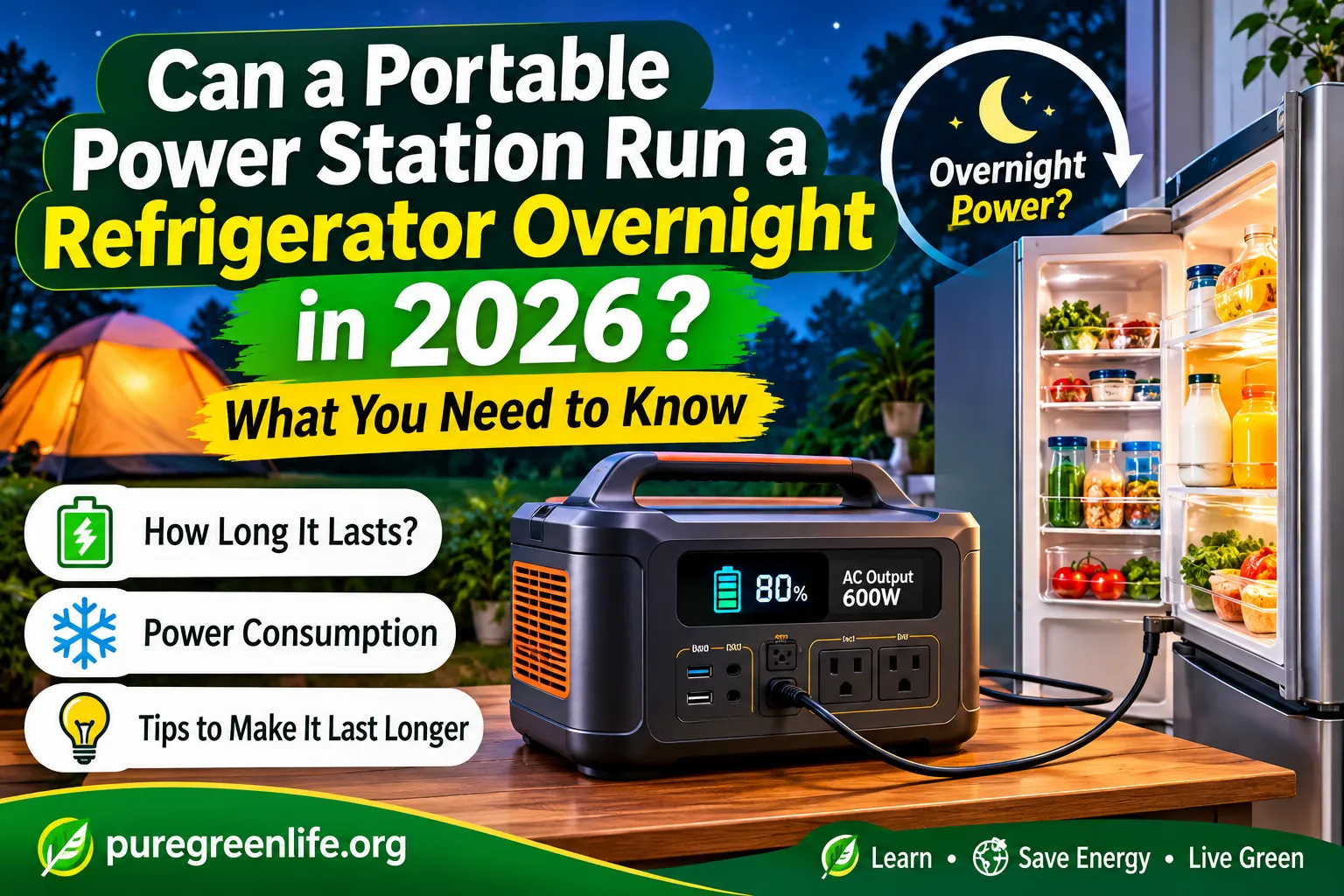
Yes, a portable power station can run a refrigerator overnight. However, it depends on the refrigerator’s energy consumption and the power station’s battery capacity. A small power station may not provide enough backup for the entire night. A larger model can keep many household refrigerators running for several hours.
Before choosing a power station, you should understand watt-hours, starting watts, and battery efficiency. These details help you estimate how long your refrigerator can operate.
This guide explains how to calculate your power needs. It also covers battery capacity, suitable power stations, and ways to extend backup time.
Can a Portable Power Station Run a Refrigerator Overnight?
A portable power station can run a refrigerator overnight if it has enough stored energy. Most refrigerators do not use electricity continuously at their maximum rated power. Their compressors switch on and off to maintain the selected temperature.
This means actual electricity consumption changes throughout the night. The refrigerator may use more energy when its compressor starts. It may use less energy when the compressor remains off.
A power station with sufficient battery capacity and output can provide reliable overnight refrigerator backup. However, you should calculate your refrigerator’s actual energy requirements before buying one.
How Much Electricity Does a Refrigerator Use Overnight?
Refrigerator electricity consumption depends on its size, age, temperature settings, and efficiency. Room temperature and how often you open the door also affect energy use.
Many household refrigerators use approximately 1–3 kWh per day. However, this is only a general estimate. Some efficient models use less, while older or larger units may consume more.
Here is an example of estimated daily and overnight energy use.
| Refrigerator type | Example daily consumption | Estimated 10-hour consumption |
|---|---|---|
| Small refrigerator | 0.5–1 kWh | 0.21–0.42 kWh |
| Medium refrigerator | 1–2 kWh | 0.42–0.83 kWh |
| Large refrigerator | 1.5–3 kWh | 0.63–1.25 kWh |
These figures are illustrative estimates, not fixed consumption rates. Your refrigerator may use a different amount of electricity.
Check the energy label or manufacturer’s specifications for accurate consumption information. A plug-in energy meter can also help measure actual electricity use.
What Size Portable Power Station Do You Need?
The right power station depends on how much electricity your refrigerator consumes. You also need to consider battery capacity and inverter output.
Battery capacity is measured in watt-hours (Wh). It tells you how much energy the battery can store.
| Portable power station capacity | General suitability |
|---|---|
| 300–500Wh | May support a small, efficient refrigerator for a limited period |
| 500–1,000Wh | May provide several hours of refrigerator backup |
| 1,000–1,500Wh | May support overnight use with an efficient refrigerator |
| 1,500–2,000Wh | Offers more backup capacity for many household refrigerators |
| Above 2,000Wh | Provides additional capacity for longer backup needs |
These ranges are starting points, not guarantees. Actual runtime depends on refrigerator consumption, inverter efficiency, and battery condition.
A larger battery generally provides longer backup time, but it does not automatically guarantee compatibility. You must also check the power station’s output rating.
How to Calculate Refrigerator Backup Time
You can estimate backup time using a simple calculation. First, find your refrigerator’s energy consumption. Then compare it with the usable energy stored in your power station.
For a basic estimate, use this formula:
\[ \text{Runtime (hours)}=\frac{\text{Usable Battery Capacity (Wh)}}{\text{Average Power Consumption (W)}} \]
For example, imagine a power station has 1,000Wh of usable energy. Your refrigerator uses an average of 80W while operating.
\[ 1000 \div 80 = 12.5 \text{ hours} \]
This example suggests approximately 12.5 hours of operation. Actual runtime may be shorter because of inverter losses and changing refrigerator consumption.
A More Accurate Calculation Using Daily Energy
Daily energy consumption can provide a better estimate for refrigerators. This is because their compressors cycle on and off.
Suppose your refrigerator uses 1.2kWh per day. Its estimated 10-hour energy requirement would be:
\[ 1200 \times \frac{10}{24}=500Wh \]
If the power station has 1,000Wh of usable battery energy, it may have enough capacity for this example.
However, you should leave some extra capacity for conversion losses and unexpected changes in consumption.
Why Starting Watts Matter When Running a Refrigerator
Refrigerators need additional power when their compressors start. This temporary demand is often called starting watts or surge power.
The normal running power may be relatively low. However, the compressor can briefly require much more power during startup.
A portable power station must handle both requirements:
- Continuous output: The power it can provide during normal operation.
- Surge output: The temporary extra power available when an appliance starts.
For example, a refrigerator might use 100W while running but require a much higher starting surge. The exact requirement depends on its compressor and design.
Always check the refrigerator’s starting requirements and the power station’s surge rating. A unit with enough battery capacity may still fail to start the refrigerator if its inverter cannot handle the surge.
Important Features to Check Before Buying
Not every portable power station is suitable for refrigerator backup. The following features can help you choose the right model.
1. Sufficient Battery Capacity
Choose a battery that can cover your expected overnight energy use. Remember to include extra capacity for inverter losses.
A larger battery can also provide more flexibility during longer power outages.
2. Pure Sine Wave Inverter
Many household refrigerators use motors and electronic controls. A pure sine wave inverter produces AC electricity with a waveform similar to standard household power.
A pure sine wave output is generally the preferred option for sensitive electronics and motor-driven appliances. Check the refrigerator manufacturer’s requirements before connecting it.
3. High Starting Power
The power station should support the refrigerator’s compressor startup demand. Check both continuous and surge output ratings.
Do not choose a model based only on its battery capacity.
4. Battery Management System
A battery management system helps protect the battery during operation. Useful protections include overcharging, overheating, short circuits, and excessive discharge.
Choose a power station with suitable safety features and clear manufacturer instructions.
5. Battery Chemistry
Many portable power stations use lithium-ion batteries. Some models use lithium iron phosphate (LiFePO4) technology.
LiFePO4 batteries are often valued for their long cycle life and thermal stability. However, product quality and warranty conditions still matter.
6. Charging Options
Solar charging can help recharge a power station during the day. Wall charging provides another option when sunlight is limited.
Some models also support car charging. Multiple charging options can be useful during extended outages.
How to Make a Portable Power Station Last Longer
You can improve backup time by reducing unnecessary electricity use. Small changes can help preserve the stored battery energy.
Keep the Refrigerator Door Closed
Opening the refrigerator door allows cold air to escape. The compressor may then work harder to restore the selected temperature.
Keep the door closed as much as possible during an outage. This helps reduce unnecessary cooling demand.
Avoid Adding Warm Food
Warm food increases the cooling workload. Try not to place large amounts of warm food inside the refrigerator during backup operation.
Allow food to cool safely before storing it.
Use Proper Temperature Settings
Extremely low temperature settings can increase electricity consumption. Follow the refrigerator manufacturer’s recommended temperature settings.
Avoid changing the settings unnecessarily during an outage.
Keep the Refrigerator Well Ventilated
Refrigerators need enough space around their ventilation areas. Poor airflow can make the compressor work harder.
Follow the manufacturer’s installation and clearance instructions.
Disconnect Unnecessary Devices
Do not connect extra appliances to the power station when refrigerator backup is your priority.
Phones, televisions, fans, and other devices can reduce the energy available for cooling.
Can a Portable Power Station Run a Refrigerator and Other Appliances?
Yes, some power stations can run a refrigerator alongside other small appliances. However, you must consider their combined power requirements.
For example, a power station might support a refrigerator and a few LED lights. Adding a microwave or electric heater could exceed its output capacity.
| Appliance | Example power use | Backup consideration |
|---|---|---|
| Refrigerator | Varies by model | Check running and starting watts |
| LED light | 5–15W | Usually low consumption |
| Wi-Fi router | 8–20W | Usually low consumption |
| Laptop | 40–100W | Depends on usage |
| Television | 50–150W | Depends on screen size |
| Microwave | 800–1,500W | Can use substantial power |
These are example ranges only. Actual appliance ratings can differ significantly.
Check the combined running load before connecting multiple appliances. Also make sure the power station can handle any starting surges.
Common Mistakes to Avoid
Choosing the wrong power station can cause unexpected shutdowns. Avoid these common mistakes when planning refrigerator backup.
Buying a Power Station With Too Little Capacity
A small battery may run a refrigerator for only a few hours. Estimate the overnight energy requirement before choosing a model.
Ignoring Compressor Starting Power
A refrigerator needs extra power when its compressor starts. A power station with insufficient surge capacity may fail to start it.
Using Only the Refrigerator’s Rated Watts
The wattage printed on a refrigerator does not always show its complete daily energy consumption. Compressor cycling changes the actual electricity use.
Use the energy label or a plug-in meter for a better estimate.
Ignoring Inverter Efficiency
Not all stored battery energy reaches the appliance. The inverter uses some energy while converting DC battery power into AC electricity.
Include conversion losses when estimating runtime.
Running Too Many Appliances Together
Additional appliances can drain the battery quickly. They can also exceed the power station’s output limit.
Keep the refrigerator as your priority during an outage.
Is a Portable Power Station Better Than a Gas Generator for Refrigerator Backup?
Both options can provide backup electricity, but they work differently. A portable power station stores electricity in a battery. A gas generator produces electricity by burning fuel.
| Feature | Portable power station | Gas generator |
|---|---|---|
| Noise | Generally quiet | Usually louder |
| Exhaust | No exhaust during normal battery operation | Produces exhaust |
| Fuel | No fuel required | Requires fuel |
| Indoor use | Only when manufacturer permits | Must not be operated indoors |
| Maintenance | Generally low | Requires engine maintenance |
| Portability | Many models are easy to move | Depends on generator size |
| Solar charging | Supported by compatible models | Usually not supported directly |
For apartment residents, a portable power station can be more convenient. It does not produce exhaust during normal battery operation.
Never operate a gas generator inside an apartment, on an enclosed balcony, or near open windows. Carbon monoxide from generators can cause serious poisoning or death.
Final Thoughts
A portable power station can run a refrigerator overnight when its battery capacity and inverter output meet the refrigerator’s requirements.
Before buying, check daily energy consumption, compressor starting power, battery capacity, and inverter efficiency. These specifications help you estimate realistic backup time.
A power station with enough usable energy can keep food cold during overnight outages. However, no single battery size works for every refrigerator.
Choose a model based on measured electricity use rather than battery capacity alone. This approach can help you avoid unnecessary costs and get more reliable backup power.
Want to explore more helpful guides about solar energy, portable power stations, and renewable technology? Visit Pure Green Life for more informative articles, practical tips, and the latest updates on sustainable living.






One thought on “Can a Portable Power Station Run a Refrigerator Overnight in 2026? What You Need to Know”