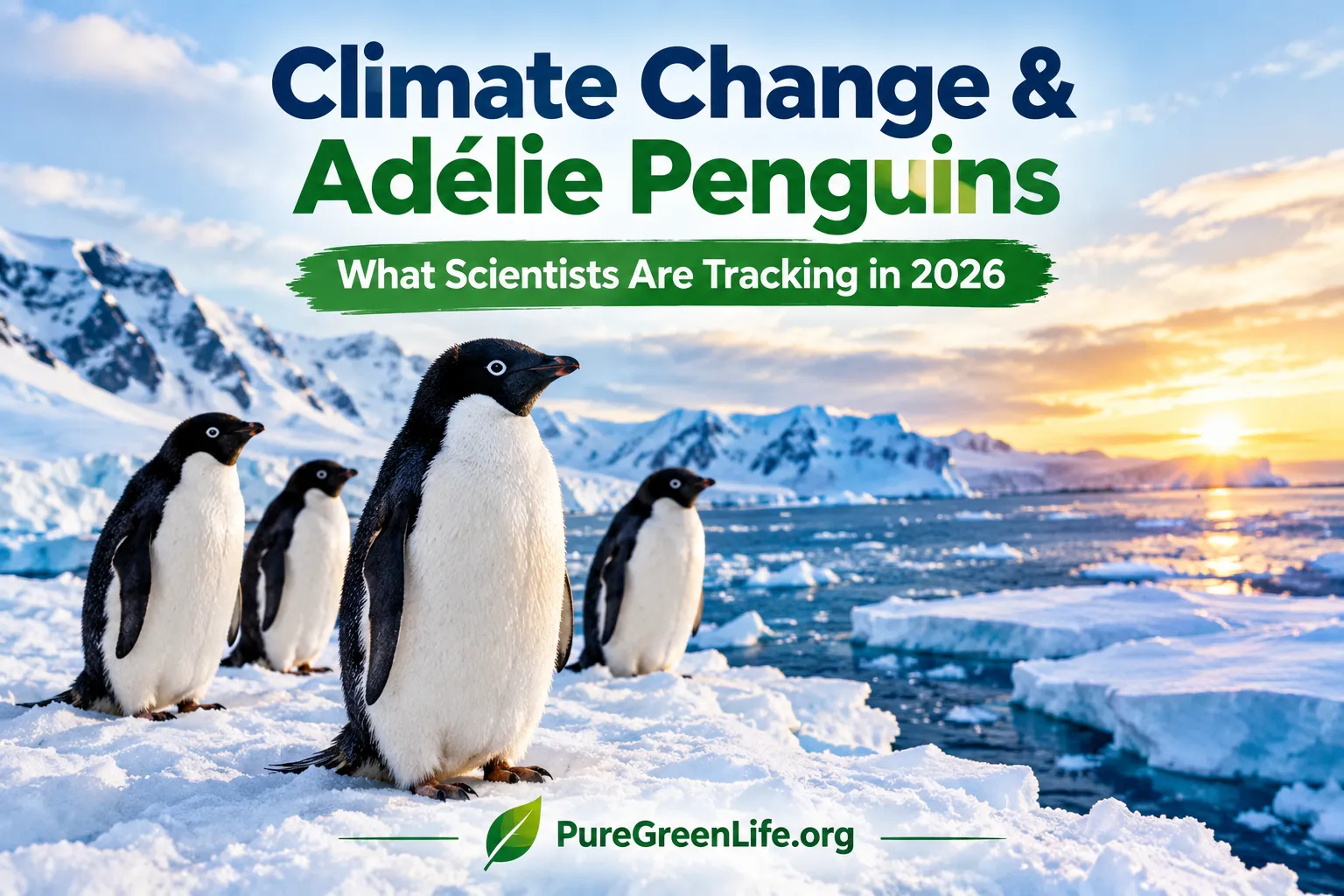
Climate change is changing the environment where Adélie penguins live. They depend on Antarctic sea ice, reliable food, and suitable nesting areas. As temperatures and ocean conditions change, some colonies face new challenges. The effects vary by location, so scientists track long-term trends.
Why Adélie Penguins Need a Stable Antarctic Environment
Adélie penguins (Pygoscelis adeliae) live around Antarctica and feed on krill, fish, and other small marine animals. Their breeding cycle depends on seasonal conditions. Sea ice can influence food webs and access to feeding areas.
🟨 Added important information: Climate change does not affect every colony in the same way. Location, sea-ice patterns, ocean temperatures, snowfall, and food availability can all influence outcomes. Scientists therefore avoid treating one colony as a perfect picture of the whole species.
How Climate Change Affects Adélie Penguins
Changing Sea-Ice Conditions
Sea ice supports Antarctic food webs. Tiny algae grow in and beneath it, helping support krill. When ice conditions change, the timing and location of food can change too. Too little or too much ice can create problems, depending on the season and location.
Adélie penguins are adapted to cold, ice-rich environments. In parts of the Antarctic Peninsula, warming and sea-ice loss have been linked with changes in penguin distribution. Other regions can experience different patterns, which makes local monitoring important.
Food Supply and Longer Foraging Trips
Adélie penguins must find enough food to maintain their own condition and feed their chicks. Changes in sea ice and ocean temperatures can affect where prey is found. If food becomes harder to reach, adults may need to spend more time searching.
Longer trips can keep parents away from nests, so chicks may receive food less often. Effects depend on prey, weather, and distance to feeding grounds.
🟨 Added important information: A 2026 study connected sea-ice conditions with penguin foraging effort and body condition. It found that high sea-ice concentration and delayed ice retreat were associated with longer trips and less diving time in the population studied. This shows why the timing of ice retreat matters, not just the total amount of ice.
Breeding Seasons Are Shifting
Penguins time breeding around seasonal food supplies and suitable nesting conditions. Warming can shift when adults arrive at breeding colonies. If food availability does not shift in step, parents may struggle to feed growing chicks.
A 2026 study using time-lapse cameras tracked breeding-season timing across 37 colonies and three penguin species. It found that Adélie, chinstrap, and gentoo penguins were settling earlier over the study period. The size of the change differed between species and locations.
🟨 Added important information: Earlier breeding is not always beneficial. It can create a mismatch between chick-rearing needs and food availability. Researchers are still studying the effect on breeding success.
Snowfall and Nesting Conditions
Adélie penguins often nest on exposed ground using small stones. Heavy snowfall or unusual weather can cover nesting areas and affect eggs or chicks. Climate change can alter precipitation patterns, although the impact varies between colonies.
Temperature alone does not explain breeding outcomes. Wind, storms, snow, and local terrain also matter, so scientists need years of observations to separate climate trends from natural variation.
Are Adélie Penguin Populations Declining?
There is no single population trend that describes every Adélie penguin colony. Some populations have declined in warming areas of the Antarctic Peninsula, while other colonies show different trends. Changes in prey, nesting habitat, sea ice, and local weather can all contribute.
A NASA-reported study from 2016 projected that climate change could put many colonies at risk later this century. These were model-based projections, not a claim that every colony would decline equally. New research continues to refine these estimates.
🟨 Important note: Population numbers can rise or fall naturally from year to year. ## H2 #4: What Scientists Are Monitoring in 2026
Researchers count birds and chicks, track adult movements, and measure conditions around colonies. Satellite images help monitor sea ice across remote areas.
Newer monitoring methods can connect several kinds of evidence. For example, a 2026 study explored how the colour of penguin guano seen in satellite imagery can provide clues about diet. The research linked year-to-year dietary shifts with sea-ice conditions. These methods may help scientists monitor remote colonies more consistently.
🟨 Added important information: Combining satellite observations with field surveys is especially useful. Satellite data can show broad patterns, while fieldwork helps confirm what is happening to individual penguins and chicks. ## H2 #5: What Could Happen in the Future?
The future of Adélie penguins will depend partly on global emissions and how sea ice and food webs respond. Some colonies may lose suitable habitat, while others may remain more stable. Predictions remain uncertain because local ecosystems differ.
How Can People Help Protect Adélie Penguins?
Reducing greenhouse gas emissions is an important long-term step. Governments and businesses can expand cleaner energy and improve efficiency. Individuals can reduce energy waste and support evidence-based climate policies.
People can support Antarctic research and marine conservation. Visitors should follow wildlife rules, keep their distance, and never disturb nests or feeding penguins.
🟨 Added important information: Conservation plans work best when they use current monitoring and protect the wider habitat, not only the places where penguins nest. Protecting marine ecosystems and managing human activity in the Southern Ocean can help reduce additional pressure on wildlife.
Frequently Asked Questions
Does climate change harm all Adélie penguins equally?
No. Effects vary by region and colony. Sea ice, food supply, weather, and local habitat all influence the level of risk.
Why is sea ice important to Adélie penguins?
Sea ice shapes the food web and can affect where prey is available. It can also influence feeding trips and breeding conditions.
Are Adélie penguins endangered because of climate change?
Their conservation status and population trends should be checked using current assessments. Climate change is a serious threat in some regions, but risks differ among colonies.
What is the most useful way to track changes?
Scientists combine long-term colony counts, field observations, animal tracking, and satellite data. ## Conclusion
Climate change is reshaping Adélie penguin habitats through changes in sea ice, food, and breeding timing. Impacts vary across Antarctica, and scientists continue to study each colony. New monitoring methods connect climate patterns with penguin behaviour and diet. Cutting emissions and protecting Antarctic ecosystems can limit future risks.
Sources for Further Reading
- British Antarctic Survey, Policy brief: Climate change and its impact on the Antarctic Peninsula: https://www.bas.ac.uk/data/our-data/publication/policy-brief-climate-change-and-its-impact-on-the-antarctic-peninsula/
- Oxford University, A two-week leap in breeding: Study reveals Antarctic penguins’ striking climate adaptation (2026): https://www.ox.ac.uk/news/2026-01-20-two-week-leap-breeding-study-reveals-antarctic-penguins-striking-climate-adaptation
- NASA, Climate Change May Shrink Adélie Penguin Range By End of Century: https://www.nasa.gov/centers-and-facilities/goddard/climate-change-may-shrink-ad%C3%A9lie-penguin-range-by-end-of-century/
- Research article, Space-based monitoring of penguin diet links sea ice, food webs, and population change (2026): https://www.sciencedirect.com/science/article/pii/S0960982226007414