
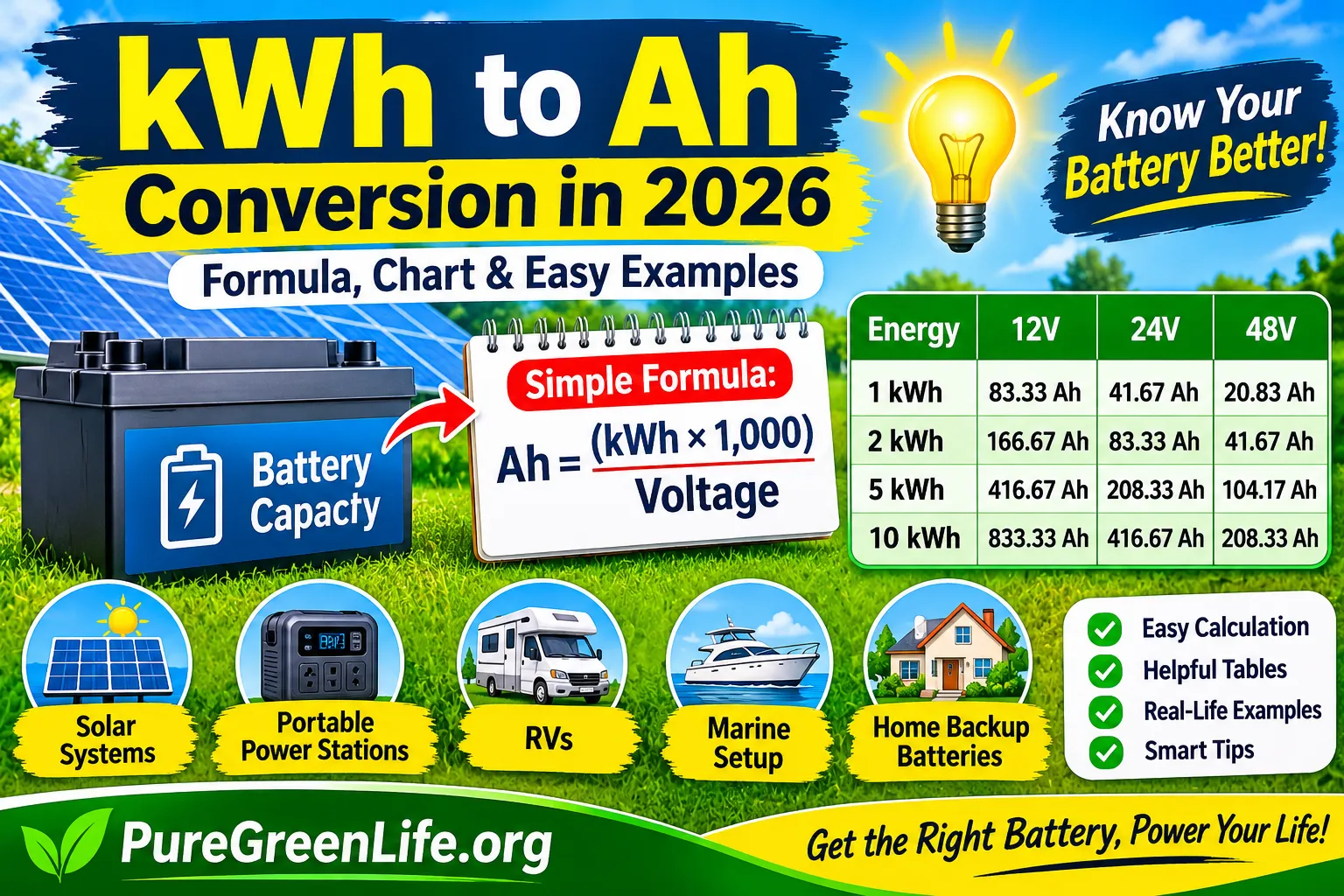
Choosing the right battery for a solar system or power station can sometimes feel confusing. Most battery specifications show two important measurements: kilowatt-hours (kWh) and amp-hours (Ah). Although both measurements describe battery capacity, they represent different electrical properties. Therefore, understanding their relationship helps you compare batteries and estimate your storage requirements more accurately.
Fortunately, converting kWh to Ah is quite simple. You only need the battery’s energy capacity and nominal voltage to perform the calculation. In this guide, you’ll learn how the conversion works, how to use its formula, and how to read conversion charts. Additionally, we’ll explore practical examples and common battery sizing mistakes.
What Are kWh and Ah, and Why Do They Matter?
Kilowatt-hours and amp-hours are common measurements in battery specifications. For example, you may find them when comparing solar batteries, portable power stations, and home backup systems. Although these units are closely related, they measure different electrical properties. Therefore, understanding each measurement separately makes battery comparisons much easier.
What Is a Kilowatt-Hour (kWh)?
A kilowatt-hour is a standard unit of electrical energy. It measures how much energy an appliance consumes or a battery stores. One kilowatt-hour equals 1,000 watt-hours, which means a device using 1,000 watts for one hour consumes 1 kWh. Similarly, a 500-watt appliance running for two hours also consumes 1 kWh.
You can also find kWh measurements on your electricity bill. Electricity providers use this unit to calculate household energy consumption. In addition, battery manufacturers use watt-hours and kilowatt-hours to describe how much energy their products can store.
What Is an Amp-Hour (Ah)?
An amp-hour measures electrical charge capacity. Battery manufacturers use this measurement to describe how much electrical charge a battery can supply over time. For example, a 100Ah battery has a rated capacity of 100 amp-hours under specified testing conditions. However, this rating does not automatically mean the battery can power every 100-amp device for one hour.
The actual performance depends on several factors. These include battery voltage, discharge rate, temperature, and operating limits. Therefore, you should consider these conditions when comparing batteries with different Ah ratings.
kWh vs. Ah: What’s the Difference?
The main difference between kWh and Ah is what each measurement represents. Kilowatt-hours measure electrical energy, whereas amp-hours measure electrical charge. As a result, both measurements provide different information about battery performance.
| Feature | Kilowatt-Hour (kWh) | Amp-Hour (Ah) |
|---|---|---|
| Measures | Electrical energy | Electrical charge |
| Common use | Energy storage and consumption | Battery capacity |
| Voltage | Included in energy calculation | Needed to calculate energy |
| Common display | Power stations and electricity bills | Battery specifications |
| Main purpose | Shows stored or consumed energy | Shows charge capacity |
Voltage connects these two measurements. Consequently, you must know the battery’s nominal voltage before converting kWh into Ah. Without this information, the calculation cannot provide an accurate amp-hour value.
How to Convert kWh to Ah
Converting kilowatt-hours into amp-hours requires the battery’s energy capacity and voltage. Once you know these values, you can apply a simple mathematical formula. Furthermore, the same calculation works with different battery voltage systems, including 12V, 24V, 48V, and 51.2V.
The kWh to Ah Conversion Formula
The standard formula for converting kWh into Ah is:
Ah = (kWh × 1,000) ÷ Voltage
Here, Ah represents battery capacity in amp-hours, while kWh represents energy capacity in kilowatt-hours. The number 1,000 converts kilowatt-hours into watt-hours. Finally, voltage represents the battery’s nominal electrical voltage.
For example, imagine a battery with 2kWh of energy capacity and a nominal voltage of 12V. First, multiply 2 by 1,000 to convert the energy into watt-hours. Then, divide the result by 12. This gives you approximately 166.67Ah of theoretical nominal capacity.
Calculation:
Ah = (2 × 1,000) ÷ 12
Ah = 2,000 ÷ 12
Ah = 166.67Ah
Therefore, a 2kWh battery operating at 12V has approximately 166.67Ah of nominal capacity. However, always check the manufacturer’s voltage rating because some batteries use values such as 12.8V, 25.6V, or 51.2V.
How to Convert kWh to Ah Step by Step
You can calculate battery capacity by following three simple steps. First, identify the battery’s energy rating in kilowatt-hours. You can usually find this information on its product label or specification sheet. For example, let’s assume your battery has a rated capacity of 5kWh.
Next, check the battery’s nominal voltage. Common battery systems include 12V, 24V, and 48V. For this example, we’ll use a 48V battery because this voltage is common in many larger solar and energy storage systems.
Finally, apply the standard conversion formula using both values. Multiply 5kWh by 1,000 and divide the result by 48V. The calculation gives approximately 104.17Ah. Therefore, a 5kWh battery at 48V has a theoretical nominal capacity of 104.17Ah.
Calculation:
Ah = (5 × 1,000) ÷ 48
Ah = 5,000 ÷ 48
Ah = 104.17Ah
kWh to Ah Conversion Chart by Voltage
A conversion chart makes battery calculations faster and easier. Instead of repeating the formula for every battery, you can simply find your energy rating and compare different voltage systems. The following chart uses the standard conversion formula, with all results rounded to two decimal places.
| Energy | 12V | 24V | 48V | 51.2V |
|---|---|---|---|---|
| 1 kWh | 83.33 Ah | 41.67 Ah | 20.83 Ah | 19.53 Ah |
| 2 kWh | 166.67 Ah | 83.33 Ah | 41.67 Ah | 39.06 Ah |
| 3 kWh | 250.00 Ah | 125.00 Ah | 62.50 Ah | 58.59 Ah |
| 4 kWh | 333.33 Ah | 166.67 Ah | 83.33 Ah | 78.13 Ah |
| 5 kWh | 416.67 Ah | 208.33 Ah | 104.17 Ah | 97.66 Ah |
| 6 kWh | 500.00 Ah | 250.00 Ah | 125.00 Ah | 117.19 Ah |
| 8 kWh | 666.67 Ah | 333.33 Ah | 166.67 Ah | 156.25 Ah |
| 10 kWh | 833.33 Ah | 416.67 Ah | 208.33 Ah | 195.31 Ah |
These figures represent theoretical nominal capacity rather than guaranteed usable energy. In actual systems, discharge limits and energy losses can reduce the amount available to appliances. Therefore, check the manufacturer’s specifications before selecting a battery.
How to Convert Ah to kWh
You can also convert amp-hours into kilowatt-hours. This reverse calculation is particularly useful when a battery specification displays Ah but does not clearly mention its energy capacity. Fortunately, you can use a simple formula for this calculation as well.
kWh = (Ah × Voltage) ÷ 1,000
For example, imagine you have a 200Ah battery with a nominal voltage of 24V. First, multiply 200 by 24 to calculate the energy in watt-hours. Then, divide the result by 1,000 to convert it into kilowatt-hours.
Calculation:
kWh = (200 × 24) ÷ 1,000
kWh = 4,800 ÷ 1,000
kWh = 4.8
Therefore, this battery has approximately 4.8kWh of nominal energy capacity. Similarly, you can use this formula for different voltage systems. However, always use the actual nominal voltage provided by the manufacturer.
Amps to kWh Conversion: Why Time Matters
Some people also want to convert amps directly into kilowatt-hours. However, current and energy are different electrical measurements. Therefore, knowing the current alone is not enough to calculate energy consumption. You also need the operating voltage and the amount of time the device runs.
For a simple DC calculation, use the following formula:
kWh = (Amps × Volts × Hours) ÷ 1,000
For example, imagine a device drawing 5 amps at 12V for 10 hours. First, multiply the current by the voltage and operating time. Then, divide the result by 1,000. This calculation gives an energy consumption of 0.6kWh.
Calculation:
kWh = (5 × 12 × 10) ÷ 1,000
kWh = 600 ÷ 1,000
kWh = 0.6
This example assumes constant voltage and current throughout operation. However, AC systems may also require power factor information for accurate energy calculations.
Practical Applications of kWh to Ah Conversion
Understanding kWh to Ah conversion is useful in several energy storage applications. For instance, homeowners use it when selecting solar batteries, while travelers may need it for RV power systems. Similarly, boat owners and off-grid users rely on battery calculations to estimate their energy requirements. Let’s explore some common applications.
1. Solar Battery Storage Systems
Solar batteries store electricity for later use. During sunny hours, solar panels can generate electricity and charge the battery. Later, the stored energy can power household appliances when sunlight becomes unavailable, such as at night or during cloudy weather.
For example, suppose your solar system requires a 10kWh battery operating at 48V. You can calculate its theoretical amp-hour capacity by multiplying 10 by 1,000 and dividing the result by 48. This gives approximately 208.33Ah. However, your final battery selection should also consider daily energy consumption, usable capacity, and charging conditions.
2. Off-Grid Living
Off-grid homes depend on stored energy when the main electricity grid is unavailable. Therefore, choosing enough battery capacity is important for keeping essential appliances running. These appliances may include refrigerators, lights, fans, and communication devices.
For example, imagine your household needs 5kWh of stored energy in a 24V system. Using the standard formula, you can calculate a theoretical capacity of approximately 208.33Ah. Nevertheless, you should also consider cloudy days, inverter losses, and your preferred backup time. This helps you choose a battery system that better matches your daily energy needs.
3. RVs and Mobile Living
Recreational vehicles often use batteries to power lights, refrigerators, fans, and electronic devices. Since these vehicles may spend time away from electrical hookups, having enough stored energy becomes especially important. Many RV electrical systems use 12V batteries, although larger setups may use higher-voltage systems or separate battery banks.
For example, a 2kWh battery operating at 12V has approximately 166.67Ah of nominal capacity. This calculation helps RV owners compare different battery options. Additionally, they can estimate whether the available storage will support their appliances during a trip.
4. Marine Battery Systems
Boats and other marine vehicles use batteries for lighting, navigation, communication, and onboard electronics. Consequently, battery capacity is important for maintaining reliable power during long journeys. A suitable battery system can help support essential equipment when shore power is unavailable.
For example, consider a marine battery with 4kWh of energy capacity and a nominal voltage of 24V. Applying the conversion formula gives approximately 166.67Ah. However, this figure represents theoretical nominal capacity. Always follow marine equipment requirements and the battery manufacturer’s installation guidelines.
5. Portable Power Stations
Portable power stations display battery capacity in watt-hours or kilowatt-hours. Some manufacturers also provide amp-hour ratings based on a specified internal battery voltage. These measurements help buyers compare energy storage options for camping, travel, and emergency backup.
For example, a portable power station with 1,024Wh of energy has a capacity of 1.024kWh. If its internal battery voltage is 12V, the theoretical amp-hour capacity would be approximately 85.33Ah. However, this calculation is only valid when 12V represents the actual internal battery voltage. Therefore, never assume that the AC output voltage is the same as the internal battery voltage.
What Affects a Battery’s Actual Usable Capacity?
The kWh to Ah formula provides a theoretical capacity estimate. However, the energy you can actually use may be different. Several factors influence real-world battery performance, including discharge limits, efficiency, temperature, and battery age. Understanding these factors helps you make better battery purchasing decisions.
1. Depth of Discharge
Depth of discharge, commonly called DoD, describes how much of a battery’s capacity has been used. Some batteries allow deeper discharge than others. However, completely discharging certain batteries can affect their lifespan or violate the manufacturer’s operating recommendations.
For example, imagine a battery with 5kWh of nominal capacity and an 80% usable discharge limit. In this case, approximately 4kWh is available before considering other system losses. Therefore, always check the recommended discharge limit when estimating usable battery energy.
2. Battery Efficiency
Batteries experience energy losses during charging and discharging. Additionally, inverters and other electrical equipment can consume some energy while converting and delivering power. As a result, the energy reaching your appliances may be lower than the battery’s advertised capacity.
For this reason, it is important to consider system efficiency when planning backup power. Moreover, comparing efficiency ratings can help you understand how much energy a battery system can deliver under normal operating conditions.
3. Temperature
Temperature can also affect battery performance. Extremely cold conditions may reduce the energy a battery can deliver, while excessive heat can affect its long-term condition. However, the exact impact depends on battery chemistry and manufacturer specifications.
Therefore, install and operate batteries within their recommended temperature range. Proper ventilation and suitable installation conditions can also help maintain reliable performance.
4. Battery Age and Condition
Battery capacity can gradually decrease as the battery gets older. In addition, frequent charging cycles, deep discharges, and unsuitable operating conditions may affect its performance. Consequently, an older battery may deliver less energy than it provided when new.
Before purchasing a used battery, check its condition and available capacity. Similarly, follow the manufacturer’s maintenance and charging recommendations to support long-term battery performance.
Common Mistakes When Converting kWh to Ah
Even though the conversion formula is simple, certain mistakes can produce misleading results. For example, some people forget to include voltage or confuse amp-hours with kilowatt-hours. Others calculate theoretical capacity but assume the entire amount is usable. Therefore, check the following details before making a battery calculation.
First, never ignore voltage because kWh cannot be converted into Ah accurately without it. Similarly, avoid confusing electrical charge with electrical energy because these measurements describe different properties. You should also use the battery’s nominal voltage rather than an unrelated AC output rating.
Additionally, remember that rated capacity does not always equal usable capacity. Inverters and other equipment can create energy losses, while battery discharge limits may reduce available storage. Finally, do not estimate battery runtime from Ah alone. You also need the appliance’s power requirements and operating conditions to make a useful estimate.
Conclusion
In simple terms, kWh to Ah conversion helps you understand battery capacity across different voltage systems. First, multiply kilowatt-hours by 1,000. Then, divide the result by the battery voltage. As a result, you can estimate the battery’s nominal amp-hour capacity more easily.
Moreover, this calculation is useful when choosing batteries for solar systems, portable power stations, RVs, and marine setups. For example, it helps you compare different battery options before making a purchase. Therefore, you can select a battery that better matches your energy requirements.
However, the calculated capacity does not always represent the energy you can actually use. Battery efficiency, discharge limits, temperature, and age can affect real-world performance. For this reason, always check the manufacturer’s specifications before choosing a battery.
Frequently Asked Questions
1. How Do You Convert kWh to Ah?
To convert kWh into Ah, multiply the energy value by 1,000 and divide the result by battery voltage. For example, a 2kWh battery at 12V has approximately 166.67Ah of theoretical nominal capacity. Therefore, knowing the voltage is essential for an accurate calculation.
2. How Many Ah Are in 1 kWh at 12V?
One kWh at 12V equals approximately 83.33Ah. You can calculate this by dividing 1,000 watt-hours by 12 volts. However, the result represents theoretical nominal capacity rather than guaranteed usable battery energy.
3. How Many Ah Are in 5kWh at 48V?
A 5kWh battery operating at 48V has approximately 104.17Ah of nominal capacity. First, multiply 5 by 1,000 to get 5,000 watt-hours. Then, divide 5,000 by 48 to get the final result.
4. Can You Convert kWh to Ah Without Voltage?
No, you cannot calculate a specific Ah value from kWh alone. Voltage is required because it connects electrical energy with electrical charge. Therefore, always check the battery’s nominal voltage before using the conversion formula.
5. Is a Higher-Voltage Battery Better?
A higher-voltage battery generally needs fewer amp-hours to provide the same amount of energy. However, this does not automatically make it the better choice. Instead, consider your system design, equipment compatibility, electrical requirements, and installation costs.
6. Does a 100Ah Battery Always Provide 100 Amps for One Hour?
No, a 100Ah rating does not guarantee that every battery can deliver 100 amps for one hour. Actual performance depends on its discharge rating and operating conditions. Additionally, high current loads may reduce the available capacity.
7. How Many kWh Does a 100Ah Battery Store?
A 100Ah battery at 12V stores approximately 1.2kWh of nominal energy. Meanwhile, the same 100Ah rating at 24V represents approximately 2.4kWh. Therefore, battery voltage makes a significant difference when comparing energy capacity.
8. Why Is Usable Battery Capacity Lower Than Rated Capacity?
Usable capacity can be lower because of discharge limits, temperature, battery age, and energy losses. Furthermore, inverters and connected equipment may consume some stored energy. Always check the manufacturer’s usable capacity rating to understand how much power your battery can actually provide.
Read More: Explore more helpful guides on solar energy, battery storage, and renewable technology at Pure Green Life.